Learning to program can seem complicated at first. There are many concepts, languages, tools, and possible paths to choose from. With so many options, it is common to be unsure which topic to study first or which materials can genuinely help along the way.
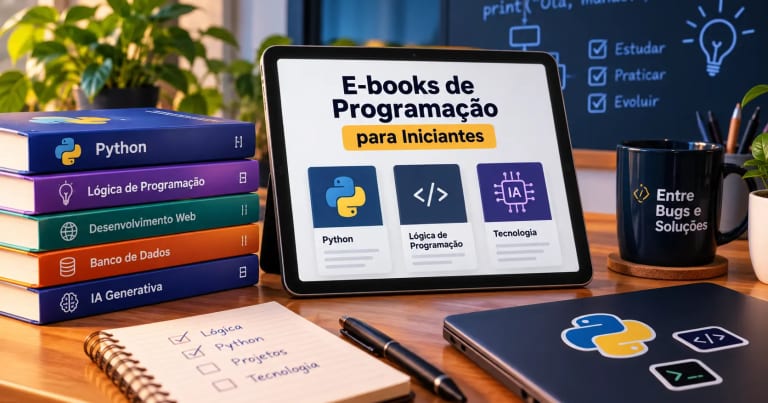
Programming e-books for beginners are an option for organizing your studies, consulting explanations, and learning at your own pace. They can cover everything from the fundamentals of programming logic to languages such as Python and other technology-related topics.
However, choosing a resource based on its title alone is not enough. It is important to consider your current level of knowledge, the topics covered, whether practical examples are included, and whether you can apply what you learn.
In this guide, you will discover how to choose programming e-books, where to start studying, and how to make the most of free and paid materials. You will also learn about the e-book library from Entre Bugs e Soluções, which brings together programming and technology content for a range of interests.
Why study programming with e-books?
E-books can serve as supporting materials for anyone who wants to learn programming in a more organized way. Since they are available in digital format, you can consult them while studying and revisit them whenever a question comes up.
One of their main advantages is the ability to progress at your own pace. You can study a concept, test an example, review an explanation, and move on when you feel ready for the next topic.
In addition, materials organized by topic help you focus on a specific goal. Instead of switching between different resources without a defined sequence, you can choose one subject and work on it until you understand its fundamentals.
Advantages and limitations of digital materials
Some advantages of e-books include:
-
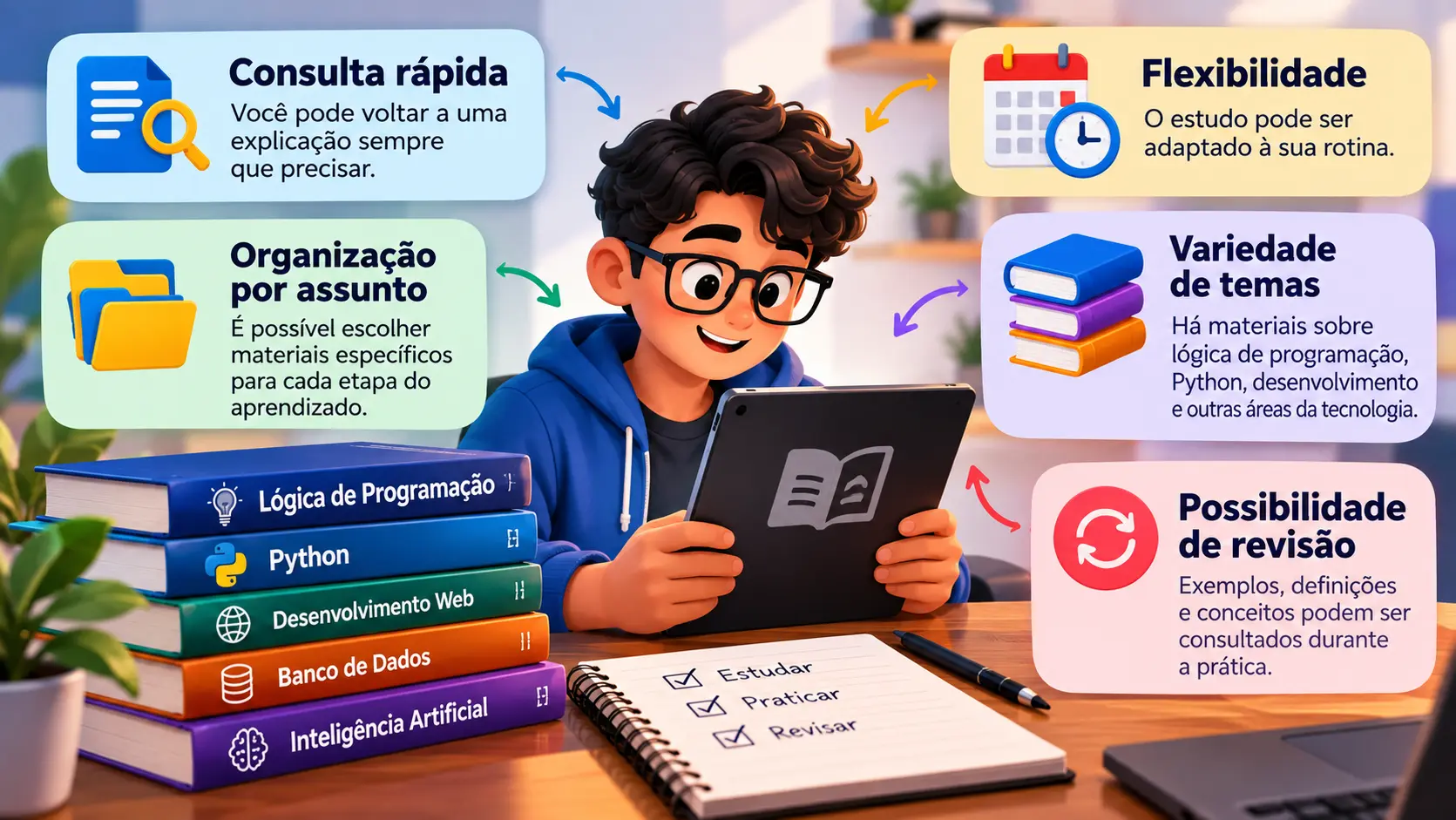
Quick reference: you can return to an explanation whenever you need to.
-
Topic-based organization: you can choose specific materials for each stage of learning.
-
Flexibility: you can adapt your study sessions to your routine.
-
A variety of topics: there are materials on programming logic, Python, development, and other areas of technology.
-
Easy review: examples, definitions, and concepts can be revisited while practicing.
On the other hand, reading an e-book does not guarantee that you will be able to apply the concepts in practice. Some topics require exercises, experimentation, and time to understand how instructions work.
That is why it is best to combine reading with practical activities. If the material presents a code example, try running it, changing its values, and observing the result.
How to combine reading and practice
Imagine that you are studying variables in Python. After understanding the explanation, try creating a small program:
nome = "Mariana"
idade = 22

print(f"{nome} tem {idade} anos.")
Next, change the name and age, run the code again, and observe the result.
This simple exercise helps turn a theoretical explanation into a practical experience. As you progress, you can combine variables, conditionals, loops, and functions to develop more complete programs.
How to choose programming e-books for your skill level
The best resource to start with is not necessarily the longest one or the one that covers the most technologies. It is the one that matches your current knowledge and helps you progress in an understandable way.
Before choosing an e-book, check its description, the topics covered, its prerequisites, and the types of examples it provides.
For people who have never programmed
If you have not written your first program yet, look for materials that explain the fundamentals without assuming prior knowledge.
Some important topics at this stage are:
-
What programming is and how a program works.
-
How to turn a problem into a sequence of instructions.
-
What algorithms are.
-
How to use variables and data types.
-
How to work with operations and expressions.
-
How to create conditionals and loops.
An introductory resource should present concepts progressively, with examples that beginners can follow.
If you come across unfamiliar terms, you do not need to learn everything at once. Identify your questions, consult the explanations, and progress gradually.
For people who already know the fundamentals
If you already understand variables, conditionals, and loops, you can look for e-books that explore specific concepts in greater depth.
At this stage, some useful topics include:
-
Functions and code reuse.
-
Lists and other data structures.
-
Program organization.
-
Error handling.
-
File handling.
-
Building small projects.
Your choice depends on what you have already studied and what you want to build. If you still have trouble organizing a program, for example, studying functions may be more useful than moving straight to frameworks or more complex tools.
The important thing is to choose a next step that matches your level rather than trying to study several topics at the same time.
Where should you start learning programming?
If you are starting from scratch, one possible sequence is to study programming logic, learn the fundamentals of a language, and then move on to specific topics.
This sequence does not need to be rigid. You can return to an earlier concept whenever you need to strengthen your understanding.
1. Start with programming logic
Programming logic involves organizing instructions to solve problems. It helps you understand how to break a task into steps and build a solution that a computer can execute.
For example, a program that calculates the average of three grades needs to receive the values, add them together, and divide the result by the number of grades.
Before worrying about a specific language, try to understand the sequence of operations needed to solve this problem.
Then look for materials that cover algorithms, variables, operators, conditionals, and loops. These concepts provide a foundation for learning different programming languages.
2. Learn Python and build your first projects
After learning the fundamentals, Python can be a good option for starting to write programs.
You can begin with simple instructions such as:
print("Hello, world!")From there, move on to variables, mathematical operations, user input, conditional statements, loops, and functions.
A good way to practice is to build small projects, such as:
-
A simple calculator.
-
A program that calculates averages.
-
A temperature converter.
-
An even-or-odd number checker.
-
A simple in-memory registration system.
These projects help you apply concepts gradually. You do not need to build something complex right away.
To review the language fundamentals, you can also use the official Python tutorial, which introduces language features and code examples.
3. Explore other technology topics
Once you have built a foundation, you can explore topics based on your interests.
Some possibilities include:
-
Web development.
-
Task automation.
-
Databases.
-
API development.
-
Generative artificial intelligence.
-
Productivity tools for developers.
You do not need to study all these areas. The best path depends on the problems you want to solve and the skills you want to develop.
If you are still exploring your preferences, introductory materials can help you learn about different areas before choosing a specialization.
Free or paid e-books: which should you choose?
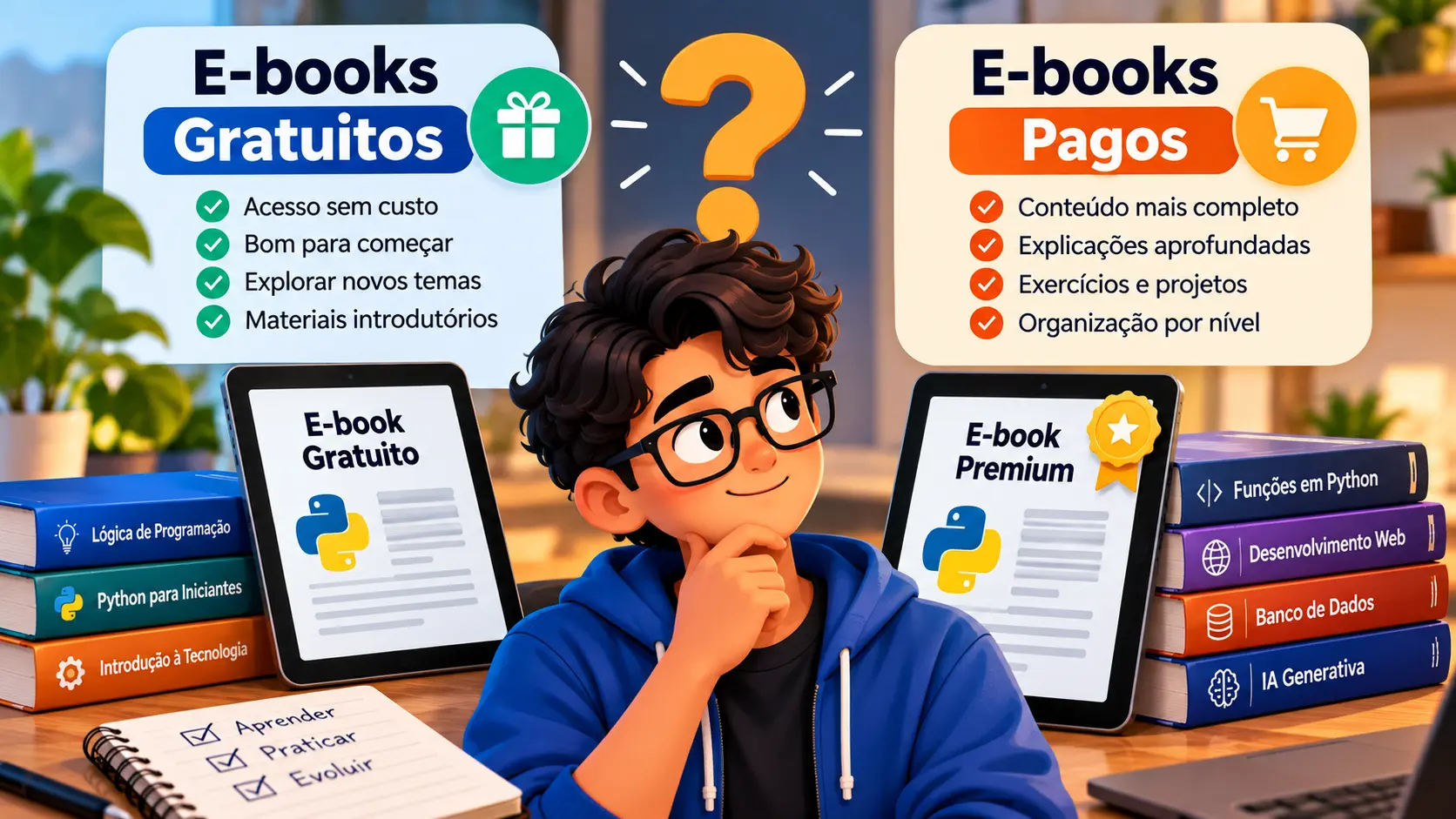
There are free and paid materials for learning programming. Your choice should take into account the content provided, the clarity of the explanations, and how well the resource fits your goal.
A free e-book may be enough to learn a specific concept or begin studying a topic. A paid resource may be worthwhile when its organization, depth, or set of exercises meets a concrete need.
Price alone does not determine the quality of the content.
Before choosing, consider the following criteria:
-
Goal: does the material cover the subject you need to study?
-
Level: are the explanations appropriate for your current knowledge?
-
Content: are the topics described clearly?
-
Practice: are there examples, exercises, or activities that help you apply the concepts?
-
Format: can you use the file on the devices and apps you have?
-
Cost: does the content offer value that fits your budget and needs?
If you are not yet sure whether a topic interests you, starting with free material can be a way to explore it. Later, if you need more in-depth explanations or a different structure, you can consider other options.
The goal is not to accumulate files, but to find materials that genuinely contribute to your learning.
How to evaluate a PDF e-book before studying
PDF is widely used to distribute digital documents, but it is not the only format available for study materials.
Before downloading or buying an e-book, check the product description to find out which file format will be provided. Do not assume that every resource is available as a PDF: formats and access conditions may vary by product.
It is also worth checking whether the content can be read comfortably on the phone, tablet, or computer you plan to use.
Pay attention to these points:
1. Content description: check which topics will be covered and whether they match your goal.
2. Clarity of explanations: look for descriptions that indicate the required level of knowledge and the approach used.
3. Practical examples: in programming, code examples help connect concepts with their application.
4. Organization: clearly defined chapters make it easier to find topics and review them.
5. Access conditions: before completing a purchase or download, check the information provided on the resource's page.
For example, when searching for Python e-books in PDF format, do not consider the file format alone. Also evaluate whether the content covers the fundamentals you need and whether you can follow the examples.
Explore the Entre Bugs e Soluções e-book library
If you are looking for materials to start learning programming or explore other technology topics, the Entre Bugs e Soluções library brings together options organized by subject.
The page features categories such as Programming and Technology, with both free and paid materials. This allows you to explore the available topics and decide which ones fit your current stage of learning.
Below are a few examples of materials that can help you explore the library.
Functions in Python
Functions are important for organizing instructions and reusing code. Studying this topic can be a good next step for anyone who already knows the language fundamentals and wants to write more organized programs.
Check out the resource Functions in Python.
Expressions in Python
Expressions are part of the operations and calculations used in programs. Understanding this topic helps you interpret instructions and build conditionals and other operations in the language.
Explore the e-book Expressions in Python: How They Work.
Generative AI for beginners
If you are also interested in technology and artificial intelligence, you can explore introductory materials on the subject.
The e-book Generative AI for Beginners is one option for learning about this topic.
These examples cover different subjects. Before choosing a resource, visit its page to check the description, content, and access conditions.
Want to explore the other available options? Visit the complete Entre Bugs e Soluções e-book library and explore programming and technology materials.
How to get the most out of your e-books
After choosing a resource, organize your study sessions so that reading turns into practical learning.
You do not need to spend several hours a day studying. The most important thing is to establish a routine that fits your schedule and maintain a consistent learning sequence.
Study one topic at a time
Avoid constantly switching between several e-books on different topics. Choose one main subject and work through its concepts progressively.
If you are learning Python, for example, you can start with variables, move on to conditionals and loops, and then study functions.
This organization makes it easier to identify questions and helps you see which knowledge needs to be reviewed.
Practice after each explanation
Whenever you come across a code example, try running it. Then change part of it and observe what happens.
If the material presents a program that adds two numbers, try adding a subtraction operation or allowing the user to enter the values.
You can also create your own exercises based on the concepts you have studied.
Keep track of questions and discoveries
Write down concepts that seemed difficult, errors you encountered, and solutions that worked.
These notes can serve as a reference during future study sessions. They also help you see which topics you can already apply and which still need review.
Build small projects
Once you understand a few fundamental concepts, try combining them in a simple program.
For example, after studying variables, conditionals, and mathematical operations, you can build a calculator. Later, you can add functions to organize its operations.
Projects do not need to be large. They should let you apply what you have already studied and identify what you need to learn next.
Conclusion
Choosing programming e-books for beginners becomes easier when you identify your current level of knowledge, define what you want to learn, and select materials that match that goal.
One possible sequence is to start with programming logic, learn the fundamentals of Python, practice with small projects, and then explore other technology topics according to your interests.
E-books can support this process, but learning also depends on practice, review, and consistency. Instead of accumulating materials, choose a topic, study its fundamentals, and apply what you have learned.
Explore the Entre Bugs e Soluções e-book library and find materials to continue your learning journey.